
Defender OCTA vs. Mercedes-AMG G 63: Choosing Ultra-Luxury Off-Road Excellence
January 02 2026,
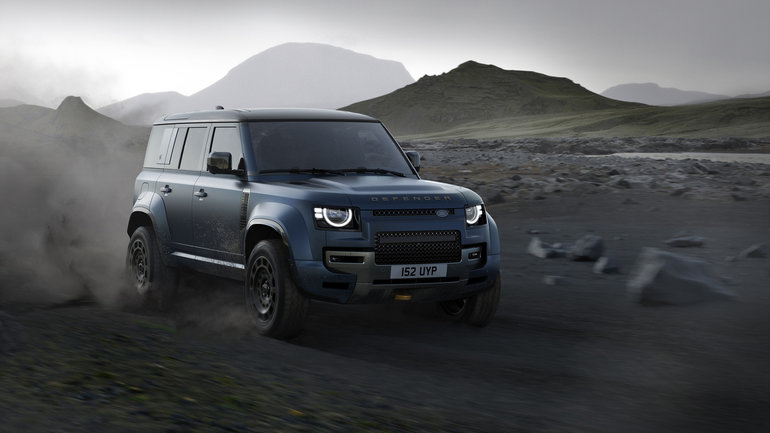
Montreal's luxury vehicle market has long favoured the Mercedes-AMG G 63 for ultra-luxury off-road capability. The Defender OCTA enters this segment with technical specifications and engineering solutions designed to challenge the G-Class dominance. Both vehicles target buyers seeking maximum performance and capability without compromise, but they achieve these goals through different engineering approaches.
Powertrain Architecture and Performance
The Defender OCTA uses a 4.4 L twin-turbo mild-hybrid V8 producing 626 hp and 553 lb-ft of torque. This BMW-sourced engine replaces the previous supercharged unit and incorporates 48-volt MHEV technology. The mild-hybrid system provides torque fill during acceleration and supports refined stop-start operation. The OCTA accelerates from 0-100 km/h in 4.0 seconds, establishing it as the fastest Defender ever produced.
The Mercedes-AMG G 63 employs a 4.0 L twin-turbo V8 generating 577 hp and 627 lb-ft of torque. This AMG-developed engine uses hot-vee turbo placement, positioning the turbochargers between the cylinder banks for reduced turbo lag. The G 63 achieves 0-100 km/h in 4.5 seconds. While the G 63 delivers higher peak torque, the OCTA's superior power output and lighter curb weight contribute to faster acceleration times.
Both vehicles use eight-speed automatic transmissions with low-range transfer cases. The OCTA features Terrain Response 2 with a dedicated OCTA mode calibrated for gravel surface performance. The G 63 uses Mercedes' 9G-TRONIC transmission adapted for off-road use, with three selectable differential lock modes for varying terrain conditions.
Revolutionary 6D Dynamics Suspension System
The defining technical innovation in the Defender OCTA is the 6D Dynamics suspension system. This hydraulically interlinked setup eliminates traditional anti-roll bars, managing pitch and roll through fluid transfer between dampers. The system uses hydraulic interconnection to link diagonally opposed wheels, allowing independent control of vertical wheel movement and body roll.
During on-road driving, the system maintains a near-level body attitude during high-speed cornering by transferring hydraulic fluid to stiffen the appropriate dampers. Off-road, the system unlocks to permit extreme wheel articulation, allowing each wheel to follow terrain independently without fighting anti-roll bar resistance. This breadth of capability—track-level body control combined with rock-crawling articulation—represents a technical achievement that solid-axle suspensions cannot match.
The Mercedes-AMG G 63 uses a more conventional approach: solid front and rear axles with coil springs and adaptive dampers. This configuration provides proven off-road durability and wheel travel. However, the solid axles and their associated anti-roll bars create inherent compromises. The suspension cannot provide the OCTA's flat cornering stance without sacrificing off-road articulation, and vice versa.
The practical result: the OCTA delivers a more comfortable daily driving experience with superior ride quality on Montreal's deteriorated road surfaces, while maintaining off-road capability that meets or exceeds the G 63. The G-Class feels truck-like on pavement, with more vertical body motion and harsher impact absorption compared to the OCTA's controlled, isolated ride.
Off-Road Capability Specifications
The Defender OCTA features a maximum wading depth of 1,000 mm, double the 500 mm rating of the original Defender. This capability addresses Quebec's spring flooding concerns and cottage access roads that may include substantial water crossings. The OCTA's approach angle of 37.5 degrees, departure angle of 40 degrees, and breakover angle of 28 degrees provide clearance for steep obstacles.
The Mercedes-AMG G 63 offers 700 mm wading depth with approach, departure, and breakover angles of 31, 30, and 26 degrees respectively. While these specifications are adequate for most off-road scenarios, the OCTA's superior angles and wading depth provide measurable advantages in extreme conditions.
The OCTA rides on 33-inch Goodyear all-terrain tires mounted on 22-inch wheels, the largest tire package ever fitted to a Defender. These provide 838 mm overall tire diameter. The G 63 uses smaller tire packages, limiting ground clearance and approach angles compared to the OCTA.
Interior Design and Technology Integration
The Defender OCTA features Body and Soul seats incorporating SUBPAC vibro-acoustic technology. This system uses six wellness programs to deliver tactile bass frequencies through the seat structure, creating a multisensory audio experience. The seats include integrated headrests and substantial side bolstering for lateral support during dynamic driving.
Interior materials include semi-aniline leather or Ultrafabrics synthetic options, with exclusive Kvadrat textile inserts unique to the OCTA. The dashboard features a 12.3-inch Interactive Driver Display and 11.4-inch Pivi Pro touchscreen with Software Over The Air update capability.
The Mercedes-AMG G 63 interior emphasizes traditional luxury materials: Nappa leather upholstery, open-pore wood trim, and metal accents throughout the cabin. The dual 12.3-inch displays use Mercedes' MBUX infotainment system. While luxurious, the G 63 interior design follows conventional luxury vehicle approaches rather than the OCTA's performance-oriented configuration.
Braking and Handling Systems

The Defender OCTA employs an Integrated Power Brake system with OCTA-specific pads, calipers, and rotors. This system improves brake pedal feel and reduces stopping distances compared to standard Defender braking hardware. The enhanced thermal capacity addresses the demands of repeated high-speed braking during performance driving.
The 6D Dynamics suspension coordinates with the all-wheel drive system and Torque Vectoring by Braking to manage handling dynamics. The system can brake individual wheels to control understeer or oversteer, maintaining the intended line through corners without requiring corrective steering inputs.
The Mercedes-AMG G 63 uses ventilated disc brakes with AMG-specific calipers painted in contrasting colours. The braking performance is adequate but not exceptional given the vehicle's 2,560 kg curb weight. The solid-axle suspension limits the effectiveness of electronic stability interventions compared to the OCTA's independent front suspension and sophisticated damper control.
Cultural Positioning and Resale Considerations
The Mercedes-AMG G 63 carries cultural cachet accumulated over four decades of production. The boxy silhouette is immediately recognizable, and the vehicle signals status through brand recognition. Resale values remain strong due to consistent demand and limited production numbers. This represents a tangible financial advantage for G 63 buyers who prioritize investment protection.
The Defender OCTA enters the market as a technical challenger without the G-Class's established cultural position. Early adopters will face greater depreciation risk as the market establishes pricing for used examples. However, the OCTA's superior engineering may attract buyers who prioritize objective performance over brand heritage.
Pricing and Value Proposition
The Defender OCTA starts at approximately $195,940 CAD for the base model, with the Edition One specification reaching approximately $215,140 CAD. These figures position the OCTA below the Mercedes-AMG G 63's typical pricing, which exceeds $200,000 CAD before options.
The pricing delta reflects market positioning: the OCTA challenges the G 63 on technical merit while undercutting on initial purchase price. Buyers must weigh lower acquisition cost against potentially higher depreciation and unproven long-term reliability.
Real-World Montreal Applications
For Montreal buyers, both vehicles address similar use cases: urban daily driving, highway travel to cottage properties, and occasional off-road excursions on unpaved access roads. The OCTA provides superior on-road comfort and handling precision, making it the better choice for buyers who prioritize daily drivability. The more sophisticated suspension translates to reduced driver fatigue on Montreal's pothole-damaged roads and smoother highway cruising.
The G 63 offers superior brand recognition and established service infrastructure. Mercedes-Benz dealership networks provide comprehensive service coverage, and parts availability benefits from decades of G-Class production. The OCTA, being new to market, may face longer parts lead times and fewer technicians with model-specific expertise.
Both vehicles handle Quebec winters effectively. The OCTA's all-terrain tires provide superior snow and ice traction compared to the G 63's typical street-oriented tire packages. However, the G 63's simpler mechanical systems may prove more durable in extended sub-zero temperature operation.
The Technical Advantage vs. The Cultural Icon
The Defender OCTA delivers measurable technical superiority: faster acceleration, more sophisticated suspension technology, superior wading depth, and better daily driving dynamics. The 6D Dynamics suspension represents genuine engineering innovation that fundamentally improves the vehicle's capability envelope.
The Mercedes-AMG G 63 offers intangible advantages: proven reliability over decades of production, stronger resale value protection, and immediate cultural recognition. The boxy design has remained essentially unchanged since 1979, creating an iconic silhouette that signals luxury SUV ownership unambiguously.
For Montreal buyers prioritizing objective performance and daily driving refinement, the Defender OCTA presents the superior choice. The vehicle excels in the conditions owners will experience most frequently: urban streets, highway cruising, and occasional unpaved cottage roads.
For buyers prioritizing brand heritage, investment protection, and cultural positioning, the Mercedes-AMG G 63 remains the established choice. The G-Class combines luxury vehicle status with off-road capability in a package that has proven its market staying power over four decades.
The choice ultimately reflects whether technical superiority or cultural cachet matters more to the individual buyer. Both vehicles deliver the capability and luxury their price points demand, but they approach these requirements through fundamentally different engineering philosophies.
Visit Décarie Land Rover in Montreal to experience how the Defender OCTA's technical innovations translate to real-world driving performance.