
Range Rover Electric: What Montréal Buyers Need to Know Before the Waitlist Closes
June 11 2026,
More than 16,000 people worldwide have already registered their interest in the Range Rover Electric. For buyers in Montréal and across Québec — who lead Canada's zero-emission vehicle adoption by a significant margin — the question is no longer whether to take an interest, but what exactly you're signing up for and how the vehicle's actual numbers compare to what you've heard.
This article is for buyers who have already decided the Range Rover Electric is worth investigating seriously, and who want accurate technical detail before initiating a conversation with Decarie Land Rover. The Range Rover Electric is the first vehicle to use the MLA-Flex platform with a fully electric powertrain, and several of its specifications are genuinely distinct from anything else currently in the luxury electric segment.
Powertrain Architecture: What Makes This One Different
The Range Rover Electric uses two permanent magnet synchronous motors — one at each axle — delivering active all-wheel drive. Combined output is 542 hp (404 kW) with 627 lb-ft (850 Nm) of torque. That output is comparable to the thermal V8 models in the current Range Rover lineup.
The battery is a 117 kWh unit built using Cell-to-Pack technology, which eliminates the intermediate module structures typically found between individual cells and the battery casing. This approach increases energy density, reduces manufacturing complexity, and improves thermal management across the pack. The cells themselves are Nickel-Manganese-Cobalt prismatic format.
The electrical architecture operates at 800 volts — the same voltage platform used in a small number of performance and premium EVs globally. This enables the DC fast-charging rate of up to 350 kW, which supports a charge from 10% to 80% in approximately 25 minutes. The inverter uses silicon carbide semiconductor technology from Wolfspeed, which reduces switching losses and allows higher switching frequencies compared to standard silicon — improving overall system efficiency.
Key powertrain specifications:
- Combined output: 542 hp (404 kW), 627 lb-ft (850 Nm)
- Battery: 117 kWh, Cell-to-Pack, NMC prismatic cells
- Architecture: 800V
- Max DC fast charge: up to 350 kW
- Charge time (10–80%): approximately 25 minutes
- Estimated EPA range: approximately 275 miles (~440 km)
- Estimated WLTP range: approximately 330 miles (~530 km)
Off-Road Capability: What Changes, What Doesn't
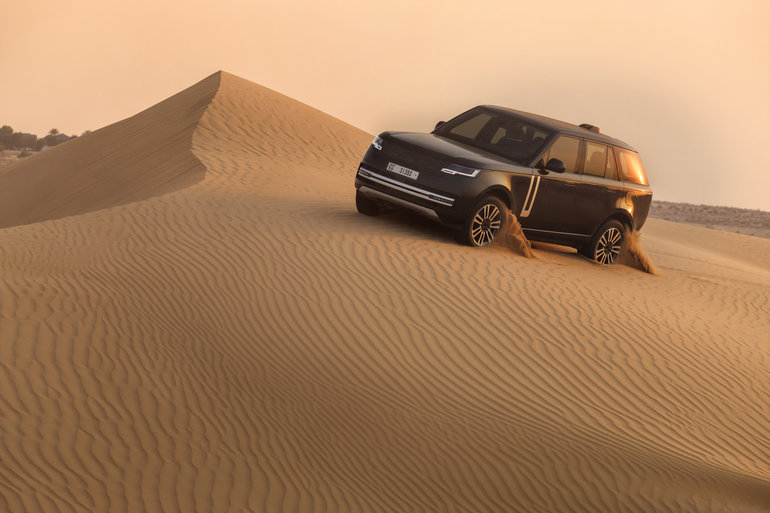
This is the section that matters most to buyers who intend to use the vehicle for anything beyond urban and highway driving. The Range Rover Electric's under-floor battery reduces ground clearance by approximately 10% compared to the thermal models — from 295 mm to 260 mm. The crest angle reduces to 23 degrees. The wading depth is 850 mm (33.4 inches), compared to 900 mm (35.4 inches) on the combustion models.
For buyers in Québec who take their vehicle to Charlevoix's gravel roads, Mont-Tremblant in shoulder season, or gravel tracks in Estrie, these reductions are meaningful but not disqualifying. The 260 mm ground clearance and 850 mm wading depth still exceed what the vast majority of SUVs — including most luxury competitors — deliver.
To compensate for the absence of a traditional transfer case, JLR developed an electronic traction system that can individually adjust torque at each wheel in one millisecond. This response time is substantially faster than mechanical torque distribution and allows the vehicle to recover traction on loose or uneven surfaces more precisely than a traditional low-range gear system in most practical scenarios.
The maximum towing capacity is 5,512 lbs (2,500 kg) — a reduction of approximately 28.6% compared to the thermal models. For buyers who do not tow, this is a non-issue. For regular towers, it remains important information.

|
Capability |
Range Rover Electric |
Thermal Range Rover (reference) |
|
Ground clearance |
260 mm |
295 mm (SWB) |
|
Wading depth |
850 mm (33.4 in) |
900 mm (35.4 in) |
|
Crest angle |
23 degrees |
27.7 degrees (SWB) |
|
Max towing |
5,512 lbs (2,500 kg) |
7,716 lbs (3,500 kg) |
|
Traction response |
1 millisecond per wheel |
Mechanical transfer case |
Why Québec Buyers Are Well-Positioned for This Vehicle
Québec accounts for 49.3% of Canada's national zero-emission vehicle sales. The province's charging infrastructure in the Montréal metropolitan area, along with the Circuit électrique network extending into the regions where Range Rover owners typically travel, makes the Range Rover Electric a viable daily vehicle in ways it may not be in other parts of the country.
The 800V fast-charging architecture is particularly relevant in Québec, where DC fast chargers are increasingly available at major service centres along provincial routes. At 350 kW maximum charge rate, the Range Rover Electric is compatible with the fastest publicly available chargers, meaning a practical top-up during a stop on the way to the Laurentians takes under 30 minutes in the best-case scenario.
For buyers who park at home overnight, the combination of a 117 kWh battery and Level 2 home charging brings the vehicle to a full charge ready for the next day's commute — with no range anxiety for any intra-provincial journey.
The Waitlist and What It Means Practically
The more than 16,000 global registrations confirm strong interest, but buyers who are serious about securing an early position should understand that the Range Rover Electric is not yet available for sale and a specific Canadian delivery timeline has not been announced in the documentation reviewed for this article. The appropriate step for buyers in Montréal is to connect with Decarie Land Rover directly to understand the current registration process and anticipated delivery sequencing for the Québec market.
Speak to Decarie Land Rover About the Range Rover Electric
The Range Rover Electric is the most technically advanced vehicle Land Rover has produced. For buyers in Montréal and Québec who want to understand where they stand on the interest list and what the registration process involves, the team at Decarie Land Rover is the right first conversation.